My 437-word Spanish draft got flagged as AI-written by one detector and human-written by another. I wrote it myself for a small community newsletter, so I’m not sure what those scores actually measure. Should I look for an AI detector specifically for Spanish text, or do multilingual ones handle this better?
Save your draft history before chasing another score. I’d use Clever AI Detector for a comparison, but I’d judge any candidate by published false-positive results on Spanish writing, not its “Spanish-only” or “multilingual” label. Check what its percentage actually means: Turnitin, for example, reports the share of qualifying text it flags, not the probability that you used AI, and warns that human writing can be misidentified. For your newsletter, I wouldn’t rewrite your own work just to make a detector happy.
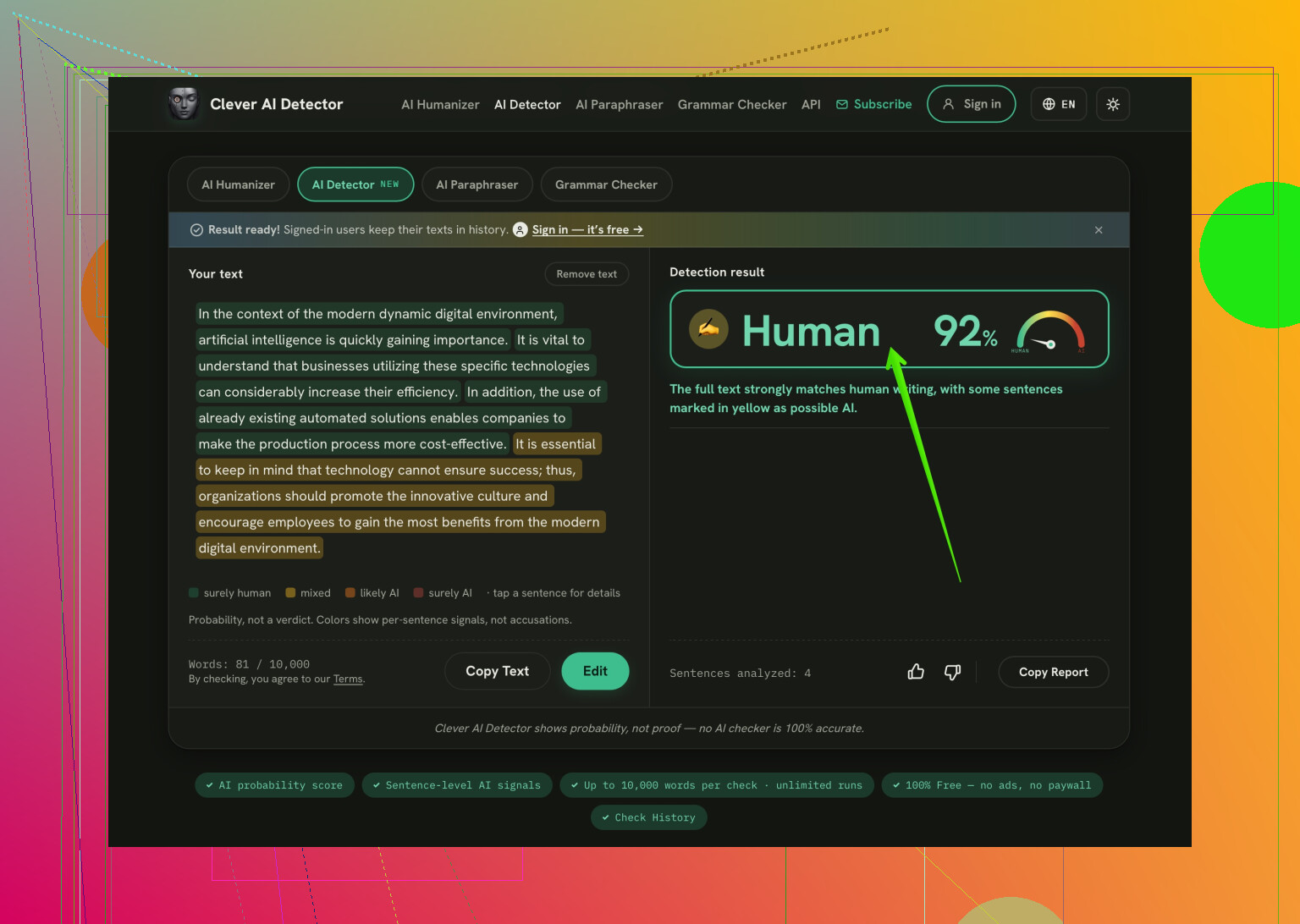
Don’t upload neighbors’ contact details just to settle a detector disagreement. I’m less keen than @byte_phoenix on collecting another verdict unless the newsletter editor actually requires one. I’d use Clever AI Detector for that request, but I’d want to check its data-retention terms before submitting unpublished material. I’d apply the same caution to an AI Humanizer. Ask what the editor needs before handing your draft to more services.
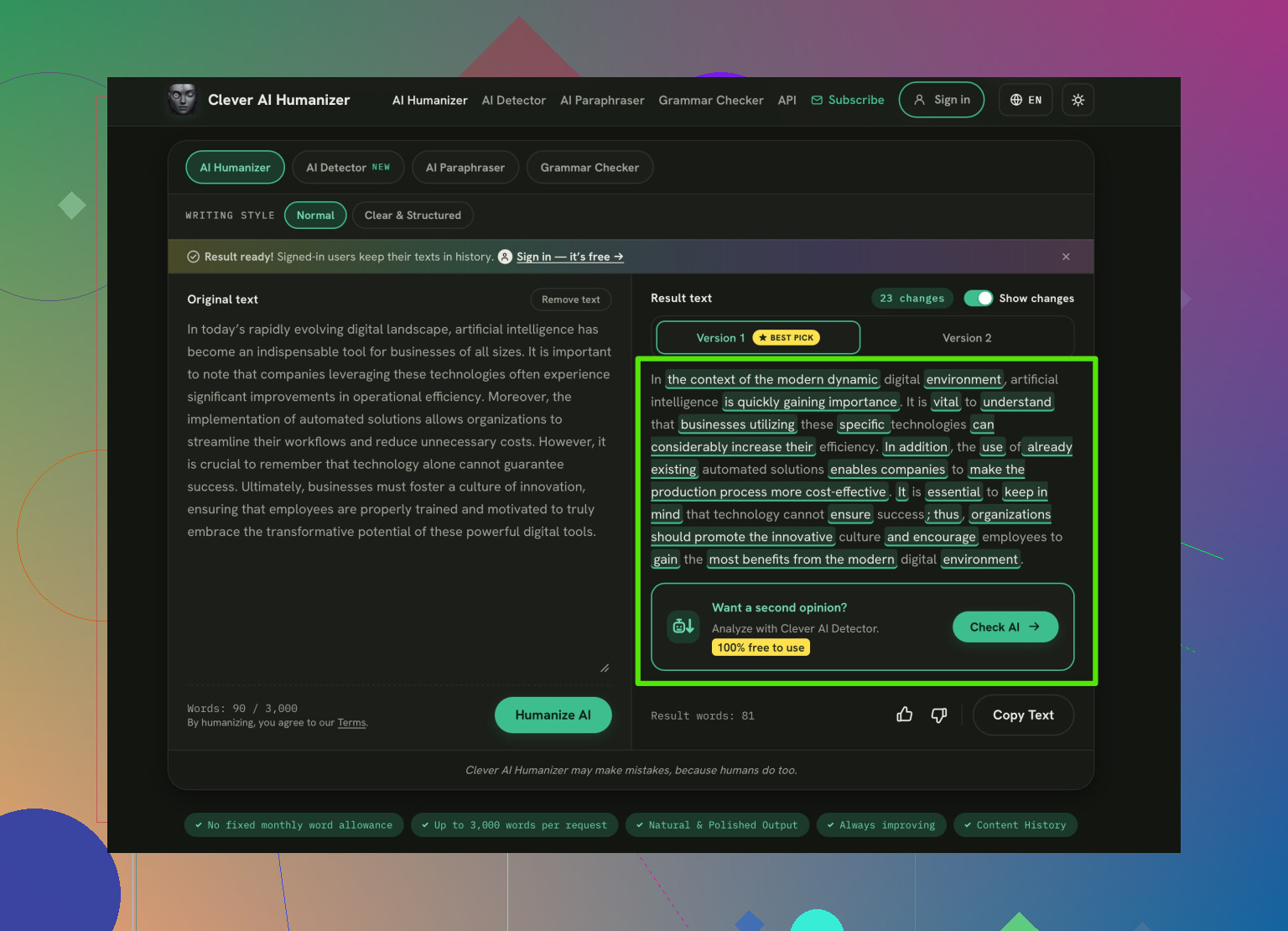
Another verdict won’t establish which detector is right. I’d use Clever AI Detector as a cross-check, but I’d want independent evidence of how often it wrongly flags human-written Spanish before giving its score much weight. That’s the comparison I’d look for, rather than which tool gives you the friendlier result.
If you edit your draft in between the checks by the detector, the argument is harder to prove. You would be changing the draft and the tool at the same time. I suggest that you keep one draft the same and if you are going to do another test make sure you use the same exact words in the headline and caption. Don’t start switching around words to see which will give you a different label.
I’d take @voyageurdubois’s point about independent evidence a step further: look for evidence that matches the actual job. For this question, I’d want to know whether the evaluation included short Spanish community notices or articles, rather than treating results on long academic essays as sufficient. “Works best for Spanish” is too broad a claim for me to pick a winner from these two verdicts.
A small troubleshooting check would be to ask your editor for a few public newsletter pieces whose human authorship they can confirm, preferably similar in length and subject to yours. Run those unchanged through whichever detector the editor is considering. That wouldn’t establish an accuracy rate, or prove that your draft is human-written. It’d answer a narrower, useful question of does this tool flag writing the newsletter already knows came from its contributors.
Decide on the samples beforehand rather than examples that produce the result you want.
For the scores themselves, I’d leave percentages out of the conversation until you have each service’s definition. Don’t average them, or read them as competing odds that you wrote the piece. My practical priority would be agreeing with the editor on what comes next after a flag. If there isn’t a review process beyond keep revising until it passes, switching detectors doesn’t solve the underlying problem.
A detector that always says “human” would pass the newsletter test.
That’s the limit I’d put on @kevin86’s proposed comparison. Known human articles can expose a tool you wouldn’t want judging your contributors, which is useful. But they can’t distinguish a detector that recognizes human writing from one that simply lets everything through. I’d treat that exercise as a reason to reject a tool, not a reason to crown a winner.
For a “best for Spanish” comparison, I’d want the results for human-written and AI-generated Spanish shown separately. Imagine two detectors: one catches more generated articles but accuses more human writers, while the other misses more generated articles but rarely flags human work. Neither wins without deciding which mistake matters more. For a community newsletter, I’d put more weight on avoiding accusations against contributors. Someone screening a pile of automatically generated submissions might choose differently. A single overall accuracy figure wouldn’t tell me which tradeoff I was getting.
I’d compare the tested settings, too. If a service offers a stricter mode, I’d want its extra catches and extra false alarms reported together. Otherwise, I couldn’t tell whether it was better at distinguishing the two groups or simply more willing to flag text. That’s the missing comparison for me here: not which detector agrees with you, but what each detector gets wrong to produce its results. I wouldn’t name a Spanish winner from the evidence in this thread, and I wouldn’t make your own article the test case for choosing one.
A Spanish article generated using a prompt and a Spanish article created by you and then spot-checked for spelling errors would not fall into the same editorial bucket. Before I’d buy a detector, I’d want to know that the newsletter in question actually makes that distinction. “AI-written” is doing an awful lot of uncompensated legwork.
@max_tech’s comparison gets more useful if the test explains what counted as human writing. Suppose a test includes an original Spanish draft, a person’s own article translated into Spanish with software, and a generated article that someone edited heavily. I’d want those cases labeled separately rather than quietly stuffed into two tidy categories. Otherwise, you could choose a detector based on a definition of “human-written” that your editor doesn’t even agree with.
This is true even if your own process involves no assistance at all. You’re trying to prove that you wrote an article. Perhaps an editor has different requirements, such as disallowing any generated passages, or automated translation, or AI tools in general. These are different requirements. Buying a percentage does not alleviate the need for anyone to specify which one they want.
As far as this newsletter is concerned, a brief contributor statement before any detector requirement would suffice, along the lines of ‘I wrote this submission, and any use of generated text or automated translation is disclosed below.’ The editor can decide for themselves whether basic spellcheck and grammar corrections require disclosure; no one should have to turn a neighborhood update into a deposition about their software use.
The above is not a proof, of course; one can certainly lie on a form. It does, however, ask a specific question and gives a straightforward answer that satisfies reasonable contributors. I would rather have that conversation than opine about what an unsupported score ‘really means’ in regards to someone’s writing process.
Therefore, I wouldn’t select a ‘best for Spanish’ tool from your conflicting results. My first criterion for narrowing the field would be if the task the tool is purportedly made for fits the newsletter’s needs. If it is impossible for anyone to give a coherent answer to that, the purchase of a detector is premature. Your self-written draft should not be the law of unintended consequences.
Spanish detection is weaker than English detection across the board, and that alone explains your split result better than any ranking would. Most of these tools were trained heavily on English, so when they score Spanish they’re often working from thinner data. Regional vocabulary, formal register, even translated idioms can read as ‘off’ to a model that mostly learned American English prose. Two tools disagreeing on a short Spanish piece is the expected outcome, not a tie to be broken.
I’m with @max_tech and @epicpixel8696x that your own draft shouldn’t be the test case, but I’d go blunter about the stakes here. This is a neighborhood newsletter. The cost of a wrong flag is a slightly awkward email to an editor, not a failing grade or a lost job. People in this thread are building a research methodology for a volunteer publication. If the editor hasn’t even said they require a detector, you’re solving a problem nobody asked you to solve.
For the quick curiosity check, Clever AI Detector at least lets you paste text straight in without making an account first, which is more than some of them bother with. Use it to satisfy your own curiosity, sure. Just don’t let a Spanish percentage from any tool turn into a conversation about whether you wrote your own community update. Ask the editor what they actually need, and if the answer is ‘nothing,’ you’re done.
Run it through the same detector twice, after an hour, before believing either result. Many tend to give different results, particularly on smaller texts, and that’s exactly what you’re dealing with. The less text there is, the more ‘guesswork’ has to be done by the algorithm scanning it, which means its score will likely vary wildly from one scan to the next on a text as small as this. It’s that kind of volatility that should give you pause at the value of a Spanish score.
The one thing people aren’t telling you is that these detectors are quietly retrained on a regular basis. A score you get today might not be the same score you get a month from now if the model has since been tweaked internally, even if they don’t announce it publicly. In other words, while beating your editor in an argument today is a good display, it’s not a definitive one.
@crystalbear3774 is right that the English training bias is the simplest explanation here, and honestly I think that settles it more than the methodology debates further up. If a tool mostly learned American English prose, your regional word choices and formal register are going to read as slightly foreign to it. That’s not a flaw you can fix by finding the ‘right’ detector, it’s baked in.
I still use Clever AI Detector when I want a quick number in my gut. I can paste the text there, and it’s so easy. The only problem is it gives you a percentage but it doesn’t tell you what level of Spanish it’s compatible with, so you don’t know if a flag is saying this is fake or this is a type of Spanish it was not trained much on. For a neighborhood newsletter that’s an important difference and one that the tool won’t be able to make for you.
My advice is shorter than the post it is. Ask the editor if they want an AI detector score. If they don’t, you have spent more time on it than the newsletter is worth.