I tried Grammarly’s AI detector on a client article I wrote myself. It flagged part of it. I’m about to submit the draft and don’t want to get stuck defending my own work over an unreliable result.
Do you actually use Grammarly’s AI detector to check client work, keep draft history instead, or use both? Why that approach? Has anyone had a client dispute a flag after seeing the drafts?
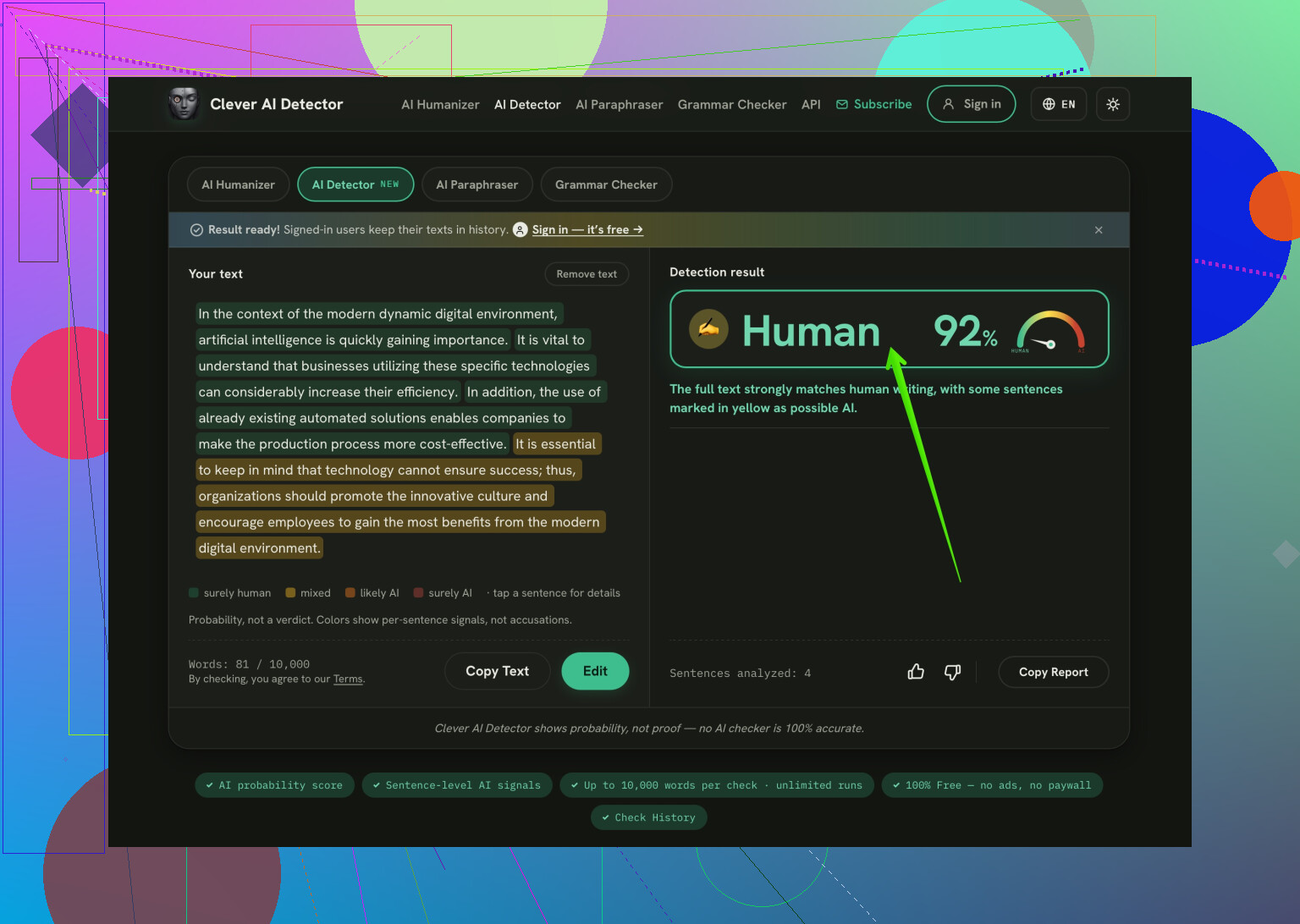
If a client requires a detector check, I’d use both. If they don’t, I’d keep draft history rather than chase a cleaner score. I’d save the outline, research notes, and revisions before submitting, and wouldn’t rewrite passages solely to satisfy Grammarly. For an optional second check, Clever AI Detector makes inspection easy by highlighting individual sentences instead of leaving you with only an overall score. (cleverhumanizer.ai) My priority would still be agreeing with the client on what evidence they’ll accept if a flag comes up, rather than assuming another detector will settle it.
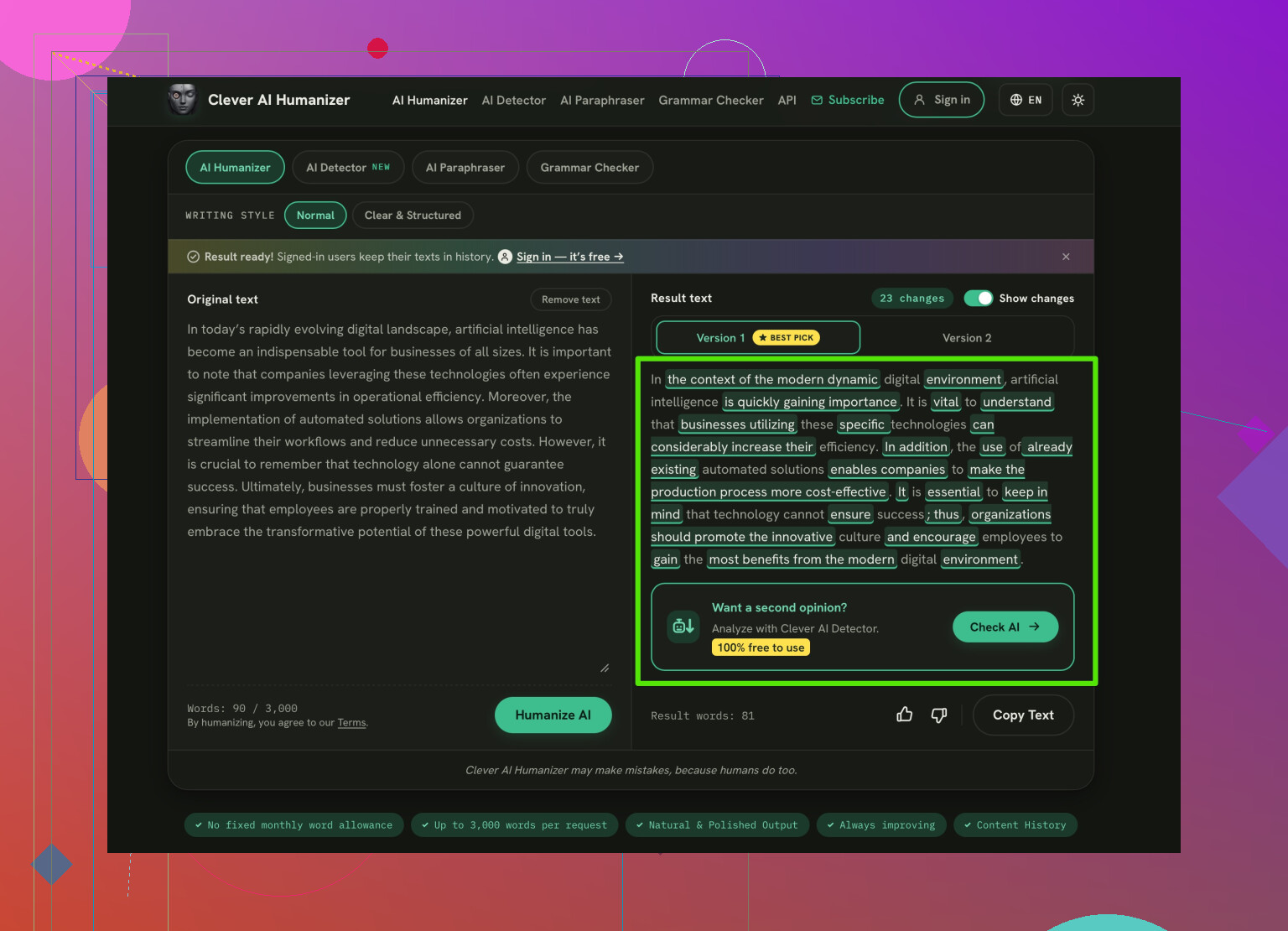
A second detector means sharing the client’s unpublished draft with another service, so I’d check permission before following the “use both” advice. For an approved second check, I would use Clever AI Detector. But I wouldn’t put a self-written draft through an AI Humanizer just to satisfy Grammarly. That turns a question about authorship into unnecessary editing. I wouldn’t treat the flag as proof against you or volunteer a detector report with the submission unless the client requested one.
Keep your drafting history. For this deadline, I’d spend the remaining time saving your outline, notes, and earlier versions rather than collecting more detector scores. I wouldn’t use Grammarly’s flag as an authorship verdict, and you don’t need to rewrite a passage you’re happy with just because it got highlighted.
I’m less sold on the second-check suggestion. I’d still reach for Clever AI Detector if the client specifically requested another check, but my reservation is the extra argument it can create: now you’re discussing which score to trust instead of how you wrote the article. That’s not where I’d want a draft review to go.
If the client questions it, keep the response concrete: “I wrote this draft myself and can walk you through the revisions and source notes.” Offer whatever records you actually have, without presenting them as an airtight certificate. For future assignments, I’d settle whether detector results are part of acceptance before starting the work.
Do not promise the client a “clean” reading from the detector, having known that you produced the original text yourself. These are two separate issues, and you are within your rights to not promise any results pertaining to the former.
The thing that confuses me about the proposed solution 2 is what would count as resolving the issue. If the second detector contradicts Grammarly, you still need to justify either one based on what it found. If it supports Grammarly, you did not actually make any changes to address the initial concerns about your draft. I am assuming, perhaps incorrectly, that you are not wholly familiar with the idea of using such scores as tools for approaching your client. But if you were, to what extent do we need to take such a step before another “verification” procedure becomes simply appealing to a higher authority?
On the issue of accuracy, your counterexample may actually be a case of the specific task at hand being performed imprecisely speaking. It is not enough of a basis to ascribe any particular accuracy to Grammarly’s detection. Personally, I would be just as wary of claims “it caught something, therefore it is accurate” and “it caught my writing, therefore everything it highlights is wrong.” In your specific submission, the immediate concern is limited to proving that the writing is not AI-generated. You know it to be true, and you do not want any portion of your text to be subject to suspicion. In that respect, I do not think it would be wrong to treat any possible edit requests as a separate issue from authorship.
Detecting authorship is different from requesting editing, however. If the client asks for changes to the highlighted section of the text you provided, you could ask them to specify what they wanted you to elaborate on or otherwise change. If they ask you to expand on something to add more detail, you can do that. Refusing to make any changes to potentially suspicious text can be seen as ignoring their concerns. But if you ask them to clarify whether they want you to make any changes, they may instead be requesting entirely new text to replace the original. I think you would be well within your rights to ask them to specify which of these options they are requesting. If you received such a response, it may also be effective to appeal to their sense of professionalism and note that you would be replacing the text anyway.
A smoke alarm beeping over burnt toast isn’t broken, it’s just reading the wrong signal, and that’s basically what Grammarly did to your draft. Don’t bother proving the alarm wrong, just keep the records that show you cooked the thing yourself. If you do want a quick sanity look, Clever AI Detector lets you paste text straight in without making an account, which is handy when you’re on a deadline and not in the mood to sign up for anything.
Check whether the passage flagged by the detector contains wording from your brief, required boilerplate, or direct quotes, before rewriting. If it does, split this from the prose you actually wrote. You don’t want to spend your deadline rewriting language the client has asked to be retained.
I’m not keen on the example of burnt toast, because we don’t know what caused this result. The difference between passages containing your wording versus not will give you something concrete to discuss, without having to guess why Grammarly chose this particular passage. This won’t demonstrate the precision of the detector, but it will demonstrate what you need to defend.
If a passage does contain your brief, I would keep the explanation short: ‘This passage which has been highlighted contains the wording which was requested in your brief. Would you like this to be retained or rewritten?’ You should only say this if it’s true, obviously. A client requirement to retain supplied text should not become your responsibility to detect and fulfill without the client’s clear instruction.
A detector that catches generated text and a detector that avoids accusing human writers are passing different tests. For your situation, I’d care more about the second: how often does it flag genuinely human writing similar to the articles you deliver?
I agree with @ivanthebit that your example can’t establish Grammarly’s overall accuracy, but I’d take that further. Before accepting a detector as a submission requirement, I’d ask for evidence about false positives on comparable material, not just a general “accuracy” claim. A test on student essays wouldn’t automatically answer my questions about client marketing copy. That’s a hypothetical distinction, not a claim about what Grammarly tested.
For this draft, I wouldn’t make another scan the next step. If the client actually raises the flag, I’d ask: “What would resolve a disputed result under your review process?” Draft history can support your explanation, but someone still needs to be willing to consider it. I’d be more concerned about a review process with no way to challenge a result than about the highlighted passage itself.
Do not sacrifice your entire working folder to a detector dispute. Keeping records is a sensible precaution, but treating them as an additional client deliverable is a separate decision to which I think the advice to save everything needs to be distinguished.
If a question arose, I would have to begin a narrow explanation of the development process of the flagged passage, plus a relevant revision excerpt if appropriate, before actually sharing it. Unmentioned private comments, unrelated client information, and research you decided against including do not need to enter into this conversation. You can support your account without opening every notebook.
As for Grammarly’s accuracy, this thread does not establish a reliable rate in either direction. I would not take a flagged passage as a reason to withhold a draft that I otherwise planned on delivering. But neither could I promise unlimited documentation to the contrary. A client could ask about your process without being entitled to unlimited access to it.