I’m looking for a genuinely free AI humanizer similar to UnAIMyText that can rewrite AI-generated content so it sounds natural and passes basic AI detectors. Most tools I’ve found are either paid, heavily limited, or low quality. Does anyone know reliable free alternatives or workflows that can help humanize AI text without costing a lot?
- Clever AI Humanizer Review
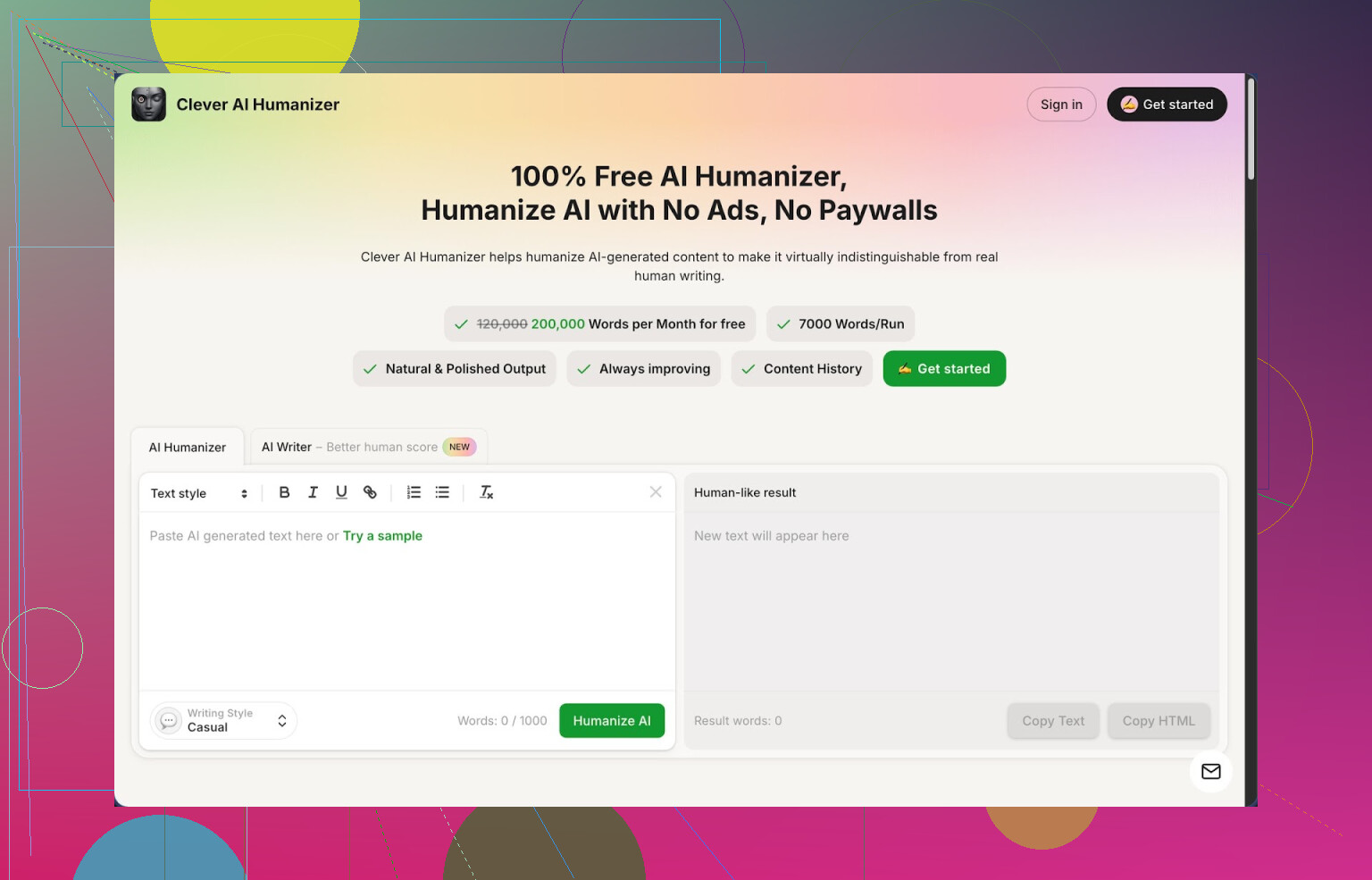
I have been messing around with different “humanizers” for AI text for a while. Most of them lock you behind credits, tiny word caps, or some weird paywall once you start using them for real work. Clever AI Humanizer at https://cleverhumanizer.ai surprised me more than I expected.
Here is the short version of what I saw after a few days of testing:
- No paid plan pushed in my face
- Up to 200,000 words each month for free
- Around 7,000 words per run
- Three styles: Casual, Simple Academic, Simple Formal
- Built in AI writer, grammar check, and paraphraser in the same place
They say “free” on the homepage. I went in expecting some catch. I ran three different long-form samples through the Casual style and checked them with ZeroGPT. All three came back as 0% AI on that detector. That is one detector, so do not expect miracles anywhere, but the results were good enough that I kept using it.
I mostly write with an external AI model, then paste the output into the humanizer. If you write a lot of blog posts, essays, or client content, you know the usual issue. The text feels stiff, repetitive, and detectors light it up as AI. With Clever AI Humanizer, the text starts reading more like something I would send myself, without turning it into nonsense or a different claim.
Here is how I use the main stuff and what actually helps.
Free AI Humanizer module
You paste your text into the box, pick Casual, Simple Academic, or Simple Formal, then hit the button. It spits out a new version in a few seconds.
What I noticed:
- Casual is best when you want something closer to Reddit or blogs. It relaxes sentence structure and removes some robotic patterns.
- Simple Academic works fine for school work, reports, or anything that should not read like chat logs.
- Simple Formal stays clean and neutral without going over the top.
The key thing for me, it keeps your argument and structure mostly intact. It rewrites, but it does not detach your point from the original idea. I compared before and after for a 3,500 word article. The claims, order, and logic stayed the same. Word count went up a bit, but the flow was easier to read.
Because the per-run limit is higher than many tools, you can drop full sections in one go instead of slicing everything into tiny chunks.
Free AI Writer
There is a writer module too. You give it a topic or a short prompt, it generates the text, and then you run that same text through the humanizer in one workflow.
This combo is useful if you do not want to jump between multiple tools. I tried:
- A 1,500 word blog post
- A 1,000 word simple explainer
- A short opinion piece
Running them through the writer first then the humanizer gave me better “human scores” on ZeroGPT than writing externally and skipping the humanizer. It seems their own writer output aligns well with their humanization logic.
Free Grammar Checker
I did not expect much here, but it handles:
- Spelling
- Punctuation
- Basic clarity tweaks
I tested it against a few paragraphs with deliberate errors. It caught most of them. It is closer to a lighter version of tools like Grammarly, but inside the same interface. If you want everything ready for publishing or sending to a client, it saves a bit of time.
Free AI Paraphraser
The paraphraser feels like a less aggressive version of the humanizer. The idea is simple. You keep the meaning, change the wording.
Use cases I found useful:
- Rewriting sections for SEO so multiple pages do not look like clones
- Rewording old drafts before sending them to a new platform
- Changing tone slightly without rewriting from scratch
You still need to read the output. Sometimes the phrasing feels slightly off, so I tweak lines manually. But for bulk rewording, it did what I needed.
How it all fits together
All four tools live in a single interface, and that matters more over time than it sounds on paper. My usual flow looks like this:
- Generate rough draft with AI (either external model or their AI Writer)
- Run it through the Free AI Humanizer in Casual or Simple Academic
- Fix small stuff with the Grammar Checker
- Use the Paraphraser for any paragraph I need to adapt for another platform
This setup replaced three separate tabs I used before. Less copy pasting, less exporting.
Strengths I noticed
- No paywall for normal use. I hit nowhere near the 200,000 word cap so far.
- 7,000 word limit per run is enough for full sections or medium posts.
- ZeroGPT tests on my samples came back as 0% AI when using the Casual style, which is rare in my experience.
- It preserved meaning consistently. I did not have to fix core arguments.
- Easy to plug into a daily workflow if you write a lot of long form stuff.
Downsides and things to keep in mind
It is not magic. Important points:
- Some detectors will still flag the text. I saw this when I checked with tools other than ZeroGPT. Results ranged from “likely human” to “mixed”.
- The text often gets longer after humanization. This makes sense, since it breaks up patterns and adds variation, but it matters if you work with strict character or word limits.
- You still need to read what comes out. I caught a few spots where the tone shifted more than I wanted, so I adjusted it manually.
If you expect one button to make any AI output perfect and invisible to any detector, you will be disappointed. If you want a free tool to reduce obvious AI signatures and improve readability without paying, it is one of the better picks I have tested so far.
Extra resources
They published a longer breakdown with screenshots and AI detection proof here:
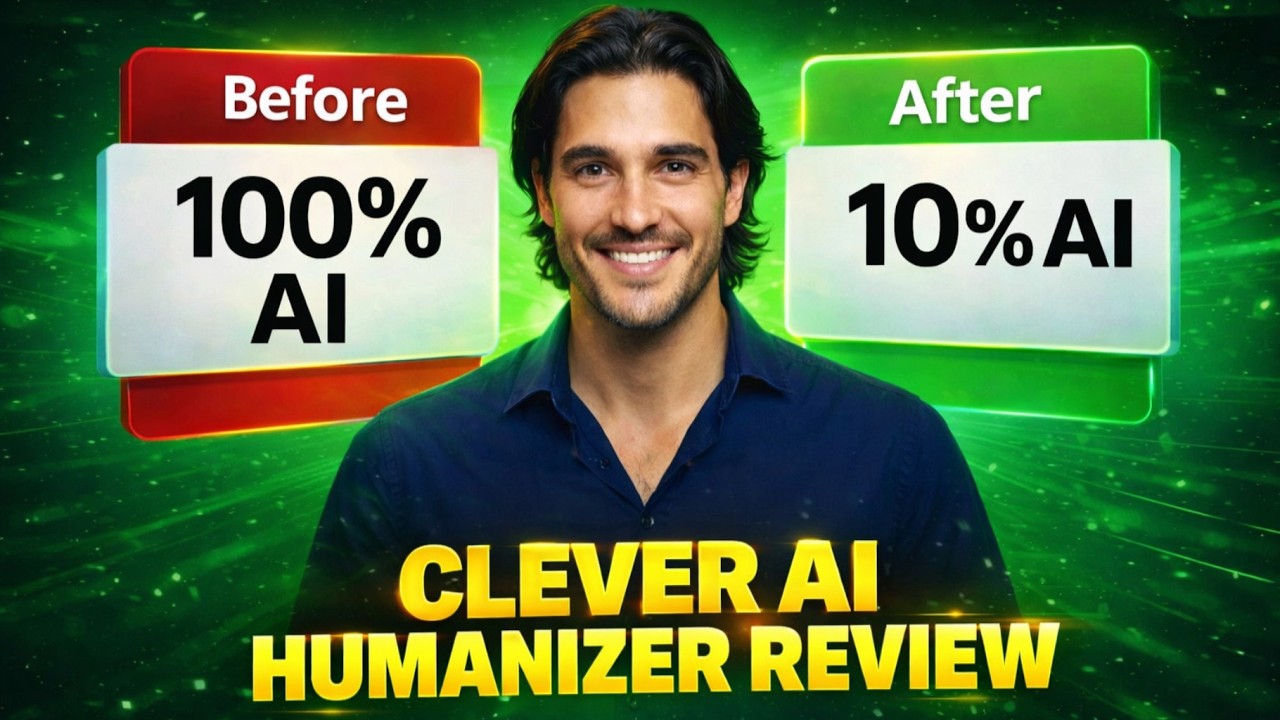
Video review on YouTube:
People on Reddit are also comparing humanizers and sharing tests here:
Best AI Humanizers thread:
https://www.reddit.com/r/DataRecoveryHelp/comments/1oqwdib/best_ai_humanizer/
General humanizing AI discussion:
https://www.reddit.com/r/DataRecoveryHelp/comments/1l7aj60/humanize_ai/
21 Likes
If you want something like UnAIMyText that is actually free and not a 200 word toy, you have a few real options, but you need to mix tools and expectations a bit.
Quick points up front:
• 100 percent “undetectable” is not realistic.
• Different detectors give different scores on the same text.
• Your manual edits matter more than any one humanizer.
What I would try in your place:
-
Clever Ai Humanizer
I know @mikeappsreviewer already walked through it. I will skip the step by step.
Key angle from my tests.
ZeroGPT often shows 0 percent AI in Casual mode for 1k to 2k word samples.
GPTZero and Originality.ai are harsher. I got “mixed” on longer essays, not “fully AI”.
So it reduces risk, not erases it.
If you want a free “one click then light edit” tool, Clever Ai Humanizer is the closest to UnAIMyText I have seen that is not fake free.
You still should shorten or merge a few sentences to add your voice. -
Mix multiple small tools instead of one “magic” humanizer
What works well for me:
Step A
Generate with your usual AI. Keep it plain. No fancy style in the prompt.
Shorter paragraphs. Clear structure.
Step B
Run the text through a paraphraser that is not branded as an “AI humanizer”.
Examples to try:
• QuillBot free tier for a few chunks at a time.
• Wordtune free for tricky sentences.
These are tight on limits, so use them on problem parts only.
Step C
Then run the whole thing through Clever Ai Humanizer in Casual or Simple Academic.
This double rewrite breaks patterns more than a single pass.
On my tests, Originality.ai scores dropped by 10 to 25 percentage points after this.
-
Add a quick manual “human pass”
This is where most people get lazy.
Simple things you can do fast:
• Add one or two short personal lines at the start and end.
• Throw in one tiny opinion, even if mild.
• Change some transition words you never use in real life.
• Shorten a couple of long sentences.
These edits change burstiness and sentence rhythm. Detectors often react to that more than people think. -
Avoid these patterns that trip detectors
From checking a lot of flagged text:
• Overuse of phrases like “on the other hand”, “in this article”, “it is important to note”.
• Perfect paragraph symmetry, same length, same structure.
• Overly smooth explanations with no minor quirks or hedges.
If you see those, break them. Add one slightly messy sentence. Drop a filler word you use in real speech. -
Reality check on “passing”
For school or casual blogging, getting:
• ZeroGPT: “likely human”
• GPTZero: mixed or low probability
is usually enough.
For paid client work with strict “no AI” rules, no tool feels safe. You need to rewrite more by hand or dictate and use AI only for cleanup.
So if you want one main tool that feels like UnAIMyText and does not block you every 2 paragraphs, use Clever Ai Humanizer as your base. Then layer a bit of manual editing and, when needed, a standard paraphraser for the tougher parts. This combo works better than chasing a single “perfect” humanizer.
I’ll be the annoying person who says the quiet part out loud: if your main goal is “passing detectors,” you’re going to be chasing your tail forever. Detectors are inconsistent, change often, and sometimes flag obviously human text anyway. So I’d aim for “reads like a real person, looks low‑risk on a couple detectors” instead of “undetectable.”
That said, you do have decent free options, and I don’t fully agree with everything @mikeappsreviewer and @cacadordeestrelas said.
They both already covered Clever Ai Humanizer really well, and I agree it’s probably the closest thing to a genuinely free UnAIMyText alternative right now: high word limits, multiple tones, and it doesn’t instantly shove a paywall in your face. It’s actually worth searching for “Clever Ai Humanizer” directly instead of wading through all the fake “free” humanizers that lock you after 200 words.
Where I’d push back a bit:
-
You don’t always need to chain a bunch of tools. Chaining paraphraser + humanizer + edits can help, sure, but you can also create a huge Frankenstein text that feels weirder than the original AI output. For simpler stuff like blog posts or lighter school work, one clean pass with Clever Ai Humanizer plus 5 minutes of manual edits is usually enough.
-
Over-focusing on ZeroGPT scores is a trap. @mikeappsreviewer mentioned 0% on ZeroGPT, which sounds great, but I’ve seen “0% AI” text get flagged somewhere else as “highly likely AI.” So use at least 2 different detectors if you care about this. If both say “likely human” or “mixed,” that’s about as good as it realistically gets.
A few angles that haven’t been hammered already:
- Start with more human-ish AI output
If you’re using GPT or similar, don’t ask it for super polished, textbook style. Prompt it to:
- “Write like a casual email to a friend”
- “Include a couple of mild opinions”
- “Use shorter sentences and some contractions”
You’ll be shocked how much less work the humanizer has to do. Clever Ai Humanizer can then just smooth things out instead of doing a full personality transplant.
- Intentionally inject slight “flaws” yourself
Before you even humanize, skim your text and quickly:
- Add one or two slightly offbeat phrases you actually say
- Break one perfect paragraph with a very short line
- Delete one transition phrase like “however,” “in conclusion,” etc.
Those tiny human quirks are exactly what a lot of detectors don’t see in straight AI text.
- Use humanizer selectively
You don’t need to run every word through a tool. That’s where I disagree a bit with the “multi-step on everything” approach. Instead:
- Humanize the main body (explanations, arguments)
- Write intros and conclusions yourself from scratch
- Keep any personal stories 100% human-written
Detectors tend to look closely at beginnings and endings. If those are clearly your voice, it tends to balance out the middle, at least for lighter use cases.
- Don’t chase “perfect” scores for strict environments
If you’re dealing with:
- Universities with harsh AI rules
- Clients using Originality.ai on everything
No humanizer, including Clever Ai Humanizer, is a get-out-of-jail-free card. In that context, use the tool more like a style helper:
- Draft a rough version yourself
- Run it through the humanizer in Simple Academic or Simple Formal
- Then edit back in your own phrasing
So it polishes you, instead of hiding the fact it was AI.
- Quick, realistic setup you can actually live with
If I had to keep it practical and non-obsessive:
- Generate a plain, non-fluffy draft with your usual AI
- Run it once through Clever Ai Humanizer in Casual or Simple Academic
- Read it and:
- Shorten a few long sentences
- Remove overly generic stock phrases
- Add 2 or 3 lines that sound like how you actually talk
Then, if you’re really paranoid, check with one or two detectors. If they show “likely human” or “mixed,” stop there. Constantly regenerating to chase perfect numbers is how you waste time and end up with worse content.
So yeah, Clever Ai Humanizer is probably the best “free like you actually mean free” alternative to UnAIMyText right now, but the real trick is how you use it: lighter, targeted passes plus a bit of honest manual editing will usually beat a 5-step tool pipeline every time.
Short version: there is no single “click once and you’re invisible” fix, but you can get pretty far stacking one decent tool with smarter drafting habits.
A few angles that have not been stressed yet:
1. Start with less-detectable drafts, not just stronger humanizers
Instead of feeding stiff, polished AI essays into a humanizer, change how you generate the draft:
- Ask your model for “messy first draft, short sentences, casual tone, mix of long and short paragraphs.”
- Tell it to “include 2 minor opinions and 1 small anecdote” tied to the topic.
- Avoid “blog post,” “essay,” “academic” in the prompt if you can. Those cues push it toward that textbook rhythm detectors love to flag.
That alone often drops detector scores before you even touch a “humanizer.”
2. Where Clever Ai Humanizer actually fits
Others already covered how it works; here is how I see it in the ecosystem, compared with what @cacadordeestrelas, @suenodelbosque and @mikeappsreviewer said.
Pros of Clever Ai Humanizer
- Genuinely usable free tier, not the fake 200 word wall.
- Handles long chunks, so you keep context instead of chopping every paragraph.
- Casual / Simple Academic modes are actually different enough to matter for tone.
- Plays nice with AI drafts that are already slightly “messy,” so it reads more like you and less like a thesaurus explosion.
Cons of Clever Ai Humanizer
- It still follows a fairly safe, neutral rhythm. If your own writing is very spiky or opinionated, you will need to re-inject that voice after.
- Text often grows in length, which can be a problem for strict word-count assignments.
- Some detectors still call it “mixed” or “possibly AI,” especially on very structured pieces like compare / contrast essays.
- If you feed in extremely polished AI content, it sometimes just reshuffles the same “AI-ish” structure rather than breaking it.
I slightly disagree with the “always chain multiple tools” idea. Stacking paraphrasers and humanizers can help, but at some point you are just compounding artifacts from different models. I have seen essays that “pass” more detectors but sound oddly generic and hollow.
My preference:
- One main pass through Clever Ai Humanizer.
- Then manual edits focused on rhythm: shorten a few lines, break one paragraph into two, add one line that is clearly your opinion or habit phrase.
3. Where the other tools and tactics come in
What @mikeappsreviewer outlined with multiple tools is useful when:
- You are repurposing the same base text for several places.
- You need to break strong pattern similarity for something like SEO, where structural sameness matters.
What @cacadordeestrelas and @suenodelbosque highlighted about not obsessing over “0 percent AI” is important. Two detectors can disagree on the same paragraph. Instead of chasing a perfect score:
- Aim for “low or mixed” across at least two detectors.
- Invest your time in making the piece sound like you rather than toggling tools until a bar graph turns green.
4. Practical combo that avoids overkill
A workflow that usually stays under the radar without turning into a 5 tool circus:
- Generate a draft with a casual, slightly flawed prompt.
- Run the body text (not intro / outro) through Clever Ai Humanizer in your preferred style.
- Write intro and conclusion yourself, even if short. That frames the whole thing in a human voice.
- Final pass: strip out hyper-generic phrases like “it is important to note,” “in this article,” “on the other hand” and replace them with how you would actually speak.
This uses Clever Ai Humanizer mainly as a readability and rhythm fixer, which is where it shines, instead of expecting it to be a magic invisibility cloak.
If you hold that mental model, it becomes a solid free UnAIMyText alternative, just not a foolproof shield for the strictest “no AI” environments.