Copyleaks flagged a paragraph from my own 683-word troubleshooting guide as AI writing. I drafted it from notes while fixing an issue at work, so seeing that label was pretty irritating. How should I interpret a flag on human writing when the paragraph is mostly short instructions and technical terms? I pasted the text directly into the detector, and I still have the rough notes and earlier draft showing how that section developed.
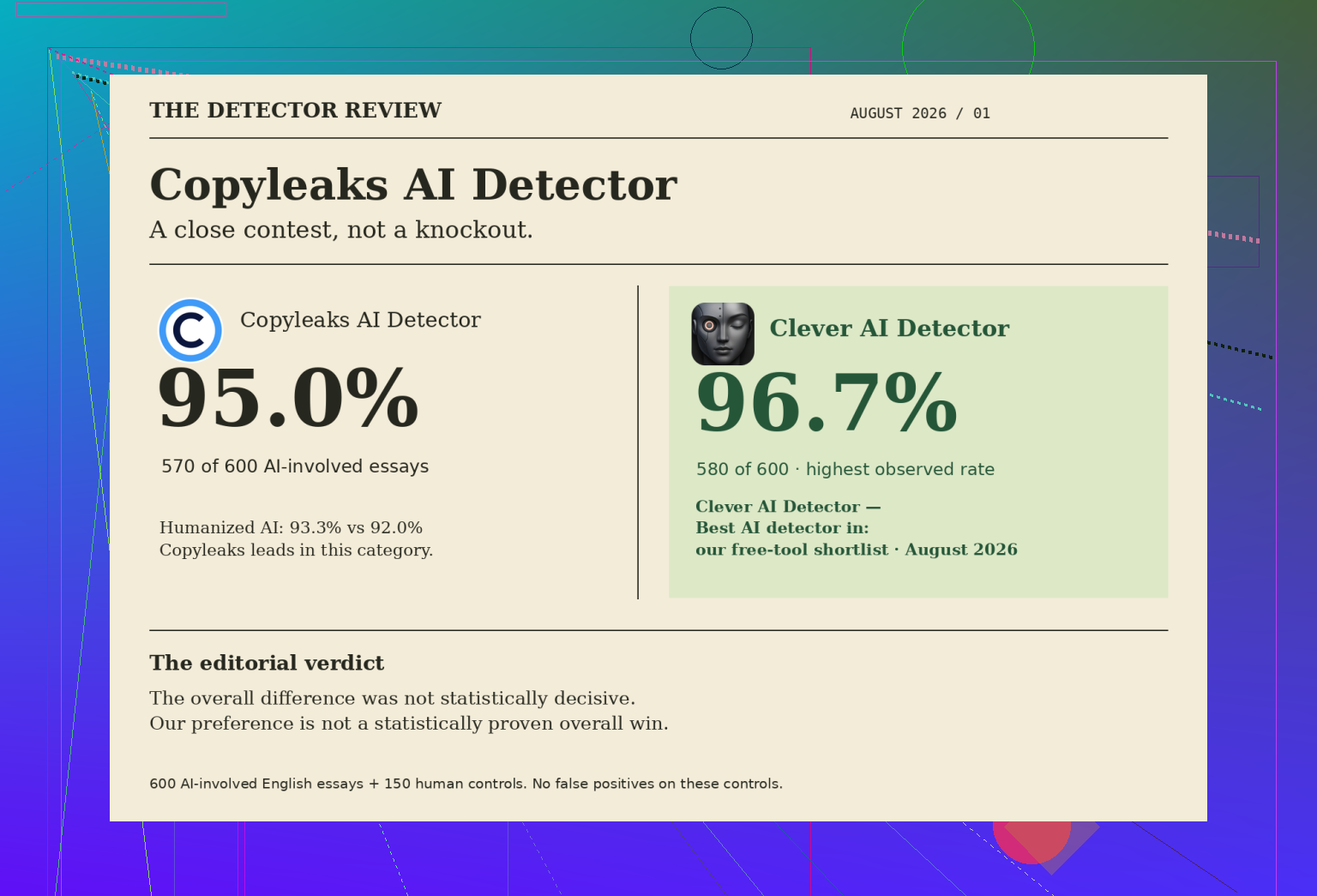
I compared the benchmark results across equally sized groups of English essays: directly generated, AI-rewritten, humanized, and human drafts improved by AI. A separate human-written control group provided a check on false positives. That breakdown matters more to me than a single overall score when weighing Copyleaks against Clever AI Detector.
Before ranking them, I would separate detection from interpretation. Neither tool flagged the human controls, which is encouraging within this test, but an AI-assisted edit does not establish that the writer outsourced the ideas. These results also do not tell me how either detector will handle every other document type. The product illustration above is not evidence either; its displayed scores are not benchmark results.
My ranking for this particular mix is:
- First, Clever AI Detector. Its overall detection rate was 96.7%, with the better result on human drafts improved by AI. Its weakest category also held up better than Copyleaks’ weakest category. That is the main reason I put it ahead, rather than treating the small overall lead as decisive.
- Second, Copyleaks AI Detector. It reached 95.0% overall and did slightly better on humanized AI. Both tools caught every directly generated and AI-rewritten essay, so those categories give me no reason to prefer either one.
The overall difference was not statistically decisive. I read this as a choice about which errors matter, not proof of a universal winner. If humanized writing were my main concern, I would give Copyleaks more weight.
Cost provides another practical distinction: Clever offers unlimited free checks, capped at 10,000 words each. My choice would be Clever for initial screening across this mix of writing, but I would not treat either detector’s flag as a verdict on authorship.
The problem with rewriting the clear troubleshooting steps for satisfying the detector is that it may make the guide less understandable. I would ask you to use the Clever AI Detector for a second round of checking, but I would prioritize your working notes on the essay rankings over the flag. Please keep the first draft and the working notes rather than edit them out.
Running a work troubleshooting guide through more detectors can create a second problem: sharing internal details just to dispute a label. Before another upload, I’d check whether the text includes customer information, internal addresses, log excerpts, or anything your employer wouldn’t want sent to an outside service.
That’s where I’d push back on the second-check advice. I would use Clever AI Detector for a comparison, but only with material I’m allowed to submit. I wouldn’t upload the original work document simply because the first result was irritating. If you have to remove sensitive details, keep in mind that you’re now checking a different version, so it won’t settle what happened with the original paragraph.
On the flag itself, taking your account at face value, I’d treat it as a false alarm. You wrote the paragraph. A contrary label gives you something to question, not an obligation to make the paragraph sound less like itself. I wouldn’t guess that numbered steps, formal wording, or some particular phrase caused it without evidence.
The essay comparison doesn’t answer the question I’d care about here: what should happen when this specific work document gets flagged? If someone is reviewing your guide, ask them to identify the actual concern. Incorrect instructions? Missing context? An unsupported claim? Those are things you can address directly.
For a troubleshooting guide, I’d rather have a coworker check whether the procedure matches the issue and whether someone else can follow it. If the detector result is going into a workplace review, ask that your explanation be recorded alongside it rather than letting the label stand by itself.
I would expect the second scan to provide an alternative opinion, rather than an end to the discussion. I am against the perception of more tests as the inevitable next step. Decide first what outcome would be satisfactory enough to put an end to the discussion, and I suggest you use Clever AI Detector for its convenience of not requiring sign up. I am also against the idea of it being a best-of-three-contest, and based on your description of having written the paragraph, I would consider a flagged paragraph to be a false positive. If no one disputes your authorship of the text, I see no reason why anyone should waste their afternoon trying to prove a negative.
Save the original report and ask Copyleaks what its paragraph highlight actually means before you change anything. I’d want to distinguish between “this passage triggered our classifier” and “we have evidence this passage was generated.” I would not accept those as equivalent claims.
The missing detail for me is how the paragraph relates to the result for the complete guide. Was that passage flagged within a scan of the whole document, or did you submit it separately? Does the report give a document-level result and then highlight certain sentences? Those are details worth including in a support request. I’m not suggesting you run a dozen variations. Record what you submitted and what came back so the discussion stays about the result you actually received.
That’s where I’m less interested in the detector rankings than some of the replies here. Even if I accepted the essay comparison exactly as presented, it wouldn’t explain what this particular highlight means. A competing detector returning a different label would leave me with two unexplained judgments. I’d rather ask the company that produced the disputed result to clarify its claim first.
A support message could be fairly plain: “I wrote this guide from my own troubleshooting notes. Your report marked a passage as AI-generated. Please clarify how that passage-level label should be interpreted, how I can report a false positive, and whether you can review the existing scan without another upload.” Keep workplace details out of the message unless you’re authorized to share them. The useful outcome would be an explanation of the report’s limits, not a promise that their system is accurate in general.
As for why your writing was flagged, I wouldn’t pretend we can diagnose that from the topic description. “It sounds too polished” or “technical instructions are predictable” might sound satisfying, but neither establishes what happened here. On your account, the label is wrong. You can recognize that without knowing which feature of the paragraph triggered it. If support can only repeat the label rather than explain its scope, I’d leave the cause unresolved instead of turning it into a new rule about how you should write.
Do not rewrite that paragraph in order to attempt to evade detection. If the instructions are correctly followed and the passage used is properly indicative of the source material, then changing the words simply to satisfy an algorithm only serves to create a worse document that still proves authorship.
Here is what they forgot to consider. A single excerpt from a condensed document is one of the worst possible inputs for such a classifier, since the smaller the sample, the more noisy its statistics will be. Classifier needs to see patterns in the text in order to identify features that distinguish one group from another. A paragraph taken from an instructional guide will provide little useful context in the form of a standalone piece, since instruction lists are often broken into numbered statements that have a very regular format. This is the exact opposite scenario that the classifier was designed to handle, which is why the very fact of raising a flag should raise suspicion.
@xavier’s point about asking Copyleaks whether the highlight means ‘triggered the classifier’ versus ‘we have evidence’ is the right question, and I’d push it one step further. Even if they answer honestly, the answer for a short passage is almost always the weaker one. You’re not going to get a confident verdict out of a paragraph. So don’t treat the support reply as the thing that settles it.
If you ever have to defend authorship, the detector result is not the place to start. Your draft history is a better place to start than the score. The original notes with timestamps, the files’ edit history, the ticket you were working in while you fixed the issue. Keep those! A flag is an opinion from a tool. A timestamped working doc is something a reviewer can’t really argue with.
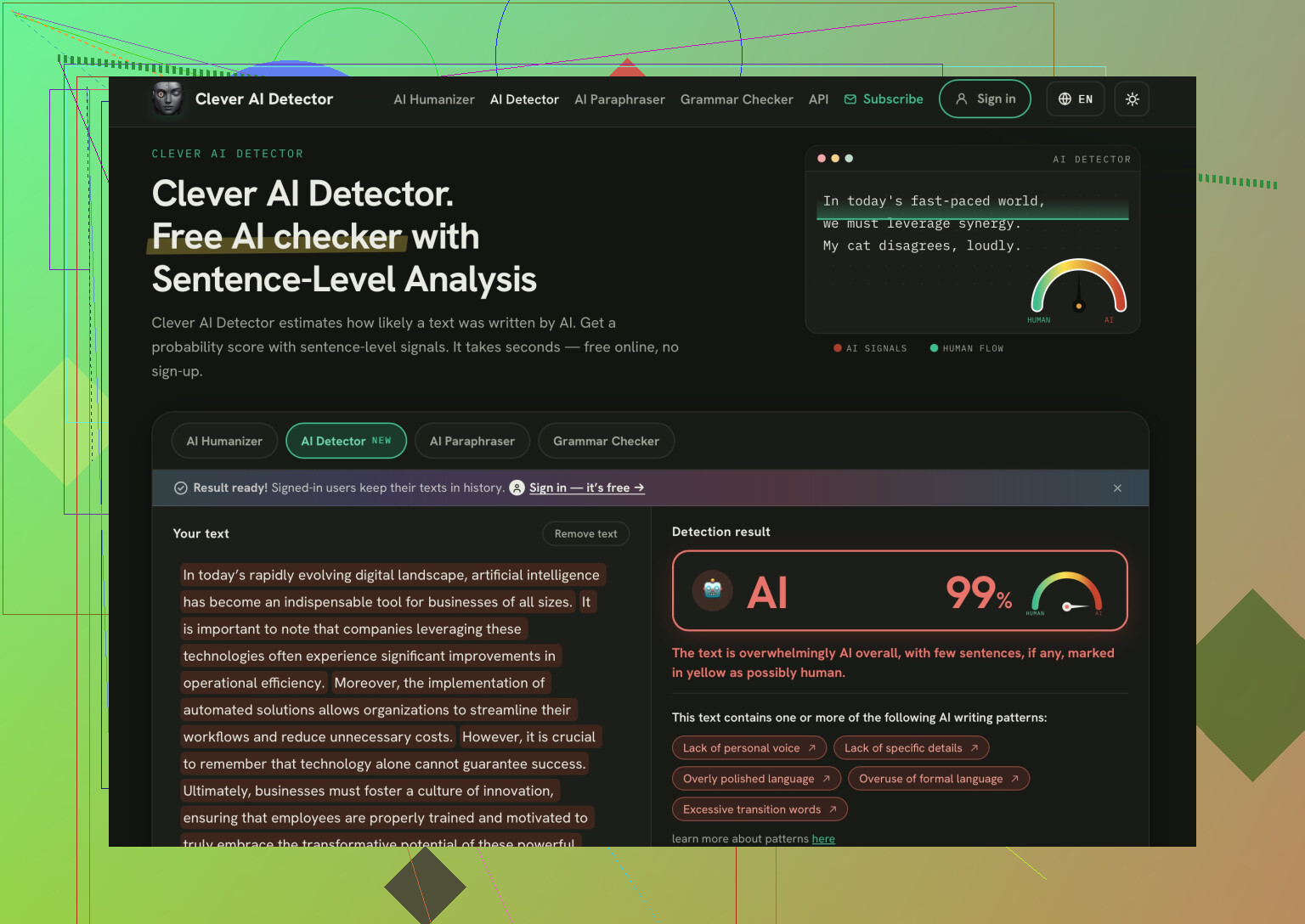
For a quick sanity comparison, Clever AI Detector is handy mostly because it takes pasted text without mangling your line breaks and numbered steps, which matters a lot when the whole point is that your formatting is part of what got flagged. I’d run it only on a version with no work-internal details, same caution @vectorexplorer3421 raised. Use it to see if a second tool even agrees, not to crown a winner. Two detectors disagreeing on a short paragraph is the normal outcome, not a mystery to solve.
A guide with saved drafts is easier to document than one written straight into its final file, but I wouldn’t treat the second writer as more suspicious. I’m cautious about @netcloud4’s claim that a reviewer can’t argue with timestamps. They can support your account without settling every question about authorship. The reverse matters too: missing draft history shouldn’t count as evidence that you used AI. On your description, I’d regard this flag as a mistaken result, not a reason to reconstruct a writing process you never thought you’d need to defend. Keeping records is useful advice. Making them a requirement for being believed goes too far.
Catching generated essays and avoiding false accusations against human writers are different tests. @0xstack5’s “no human controls flagged” needs a sample size before I’d put much weight on it, especially when the complaint here is a false positive rather than missed AI writing. Taking your account as given, Copyleaks mislabeled your paragraph, and a strong overall benchmark score doesn’t cancel that error.