I’ve been using Writesonic’s AI humanizer to rewrite AI-generated content so it sounds more natural and less detectable, but I’ve hit the paywall and can’t afford the subscription right now. I’m looking for reliable, truly free tools or workflows that can humanize AI text without ruining quality or tone. What free alternatives are you using that still pass AI detection checks and work well for blog posts or client work?
- Clever AI Humanizer, my take
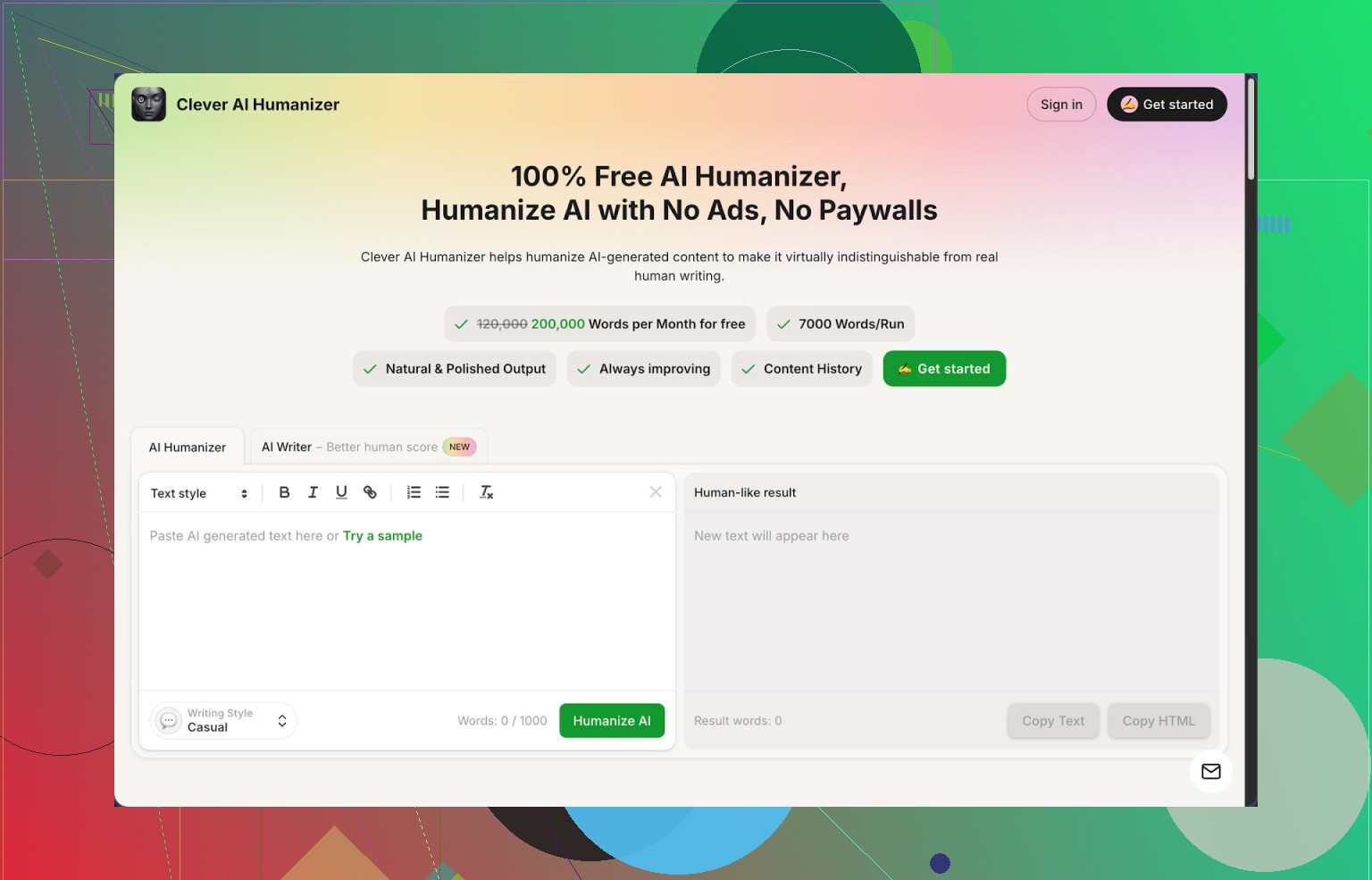
Link: https://cleverhumanizer.ai
I have been trying different “humanizers” for AI text for a while, mostly for long reports and client docs. Out of everything I poked at, Clever AI Humanizer stayed on my bookmarks bar, for one boring reason: it solves a real problem without nagging me for money every five minutes.
Here is what stood out after a few weeks of use.
Free plan and limits
You get:
- Around 200,000 words per month on the free plan
- Up to about 7,000 words per run
No credit system, no daily drip, no “you hit your quota, upgrade now” popup every second page of text. For long-form content or school work, those limits are enough for full essays, multi-section blog posts, or a whole chapter in one pass.
Styles and the main “humanizer”
The core tool is the “AI Humanizer” part.
What I do:
- Paste the AI output
- Pick a style:
- Casual
- Simple Academic
- Simple Formal
- Hit the button and wait a few seconds
The Casual style feels the least robotic to me. Shorter sentences, fewer stiff phrases. For reports, I switch to Simple Academic, which keeps the structure cleaner.
I tested it against ZeroGPT using three different samples in Casual mode. Every one came back as 0% AI on that detector. That does not mean every detector on earth will say “human”, but for ZeroGPT it passed across all three samples.
Quality and meaning
The big risk with these tools is that they mangle meaning or inject random fluff. Clever Humanizer did not do that much in my tests.
What I noticed:
- It keeps the original point intact most of the time
- It changes phrasing enough to break the “AI rhythm”
- It often expands sentences a bit, sometimes more than I want
You end up with slightly longer text in many cases. That seems intentional, since padding and variation help avoid obvious patterns. If you need tight word counts, you have to trim manually afterward.
Other tools inside the same site
Everything is in one interface at https://cleverhumanizer.ai, which helps if you are doing a full workflow: draft, fix, humanize, tweak.
Here is how I used each part.
- Free AI Writer
You enter a prompt like “write a 1,500 word blog post about X” and it generates a draft. Right after that, you run the same content through the humanizer in one go.
This combo tended to score better on detectors than taking text from another AI and pasting it in. Feels like they tuned both pieces to work together.
Good for:
- Students writing essays who need something that does not scream “AI output”
- Niche blog posts where you want a fast first draft then a less robotic version
- Free Grammar Checker
This is your basic clean-up tool for:
- Spelling
- Punctuation
- Some clarity issues
I used it after manual edits, to catch the small stuff I missed. It is not as deep as something like full Grammarly, but enough to ship emails, posts, and short articles without obvious mistakes.
- Free Paraphraser
This one rephrases content without changing the main meaning.
I used it for:
- Rewriting sections of old posts to avoid self-duplication
- Adjusting tone from “over formal” to something lighter
- SEO tweaks where you want a different wording for similar info
It behaves milder than the humanizer. It keeps structure closer and shifts phrasing, which is useful when you do not want the whole piece rewritten.
Daily workflow use
Clever AI Humanizer ended up as a 4-in-1 thing:
- Humanizer
- AI writer
- Grammar checker
- Paraphraser
All on the same site, no hopping between tabs or uploading files anywhere else. For “I have to finish this text in one sitting” days, that helps a lot.
My rough workflow:
- Draft in their AI Writer or another AI
- Run it through the Humanizer with Casual or Simple Academic
- Quick manual edits for voice and length
- Grammar Checker for final polish
- Optional: Paraphraser for any chunk that still feels stiff
It is not perfect, but it cuts the time I spend rewriting AI sludge into something passable.
Drawbacks
It is not magic. Some downsides I ran into:
- Some AI detectors still flag parts of the text as AI, especially the more aggressive ones or private ones used by schools
- Word count often increases after humanization, which can be annoying for strict limits
- You still need to read and edit, or the text can feel slightly too smooth or generic in places
For a fully free tool, these tradeoffs felt acceptable. If you expect zero detection across every system, that expectation is off. Treat it as a helper, not a cloak.
Extra links and deeper reviews
If you want a more technical breakdown with screenshots and detection tests, this longer review helped me when I first checked it out:
There is also a YouTube review here, worth a watch if you prefer video:
Some Reddit threads where people swap experiences and tools, including this one:
Best AI Humanizers on Reddit
https://www.reddit.com/r/DataRecoveryHelp/comments/1oqwdib/best_ai_humanizer/
General discussion about humanizing AI text, pros, cons, and detector talk:
https://www.reddit.com/r/DataRecoveryHelp/comments/1l7aj60/humanize_ai
If you write with AI a lot and hate spending an hour rewriting every paragraph so it sounds like you, Clever AI Humanizer is worth trying. Treat it as a decent starting point, then layer your own voice on top.
15 Likes
I hit the same wall with Writesonic’s humanizer, so here’s what worked for me after a lot of trial and error.
First, I agree with @mikeappsreviewer on one thing. Most “AI humanizers” nag for money and have tiny limits. That got old fast. I do think they lean a bit too much on detector screenshots though. Detectors are inconsistent. I would not trust any tool only because it scores 0 percent on one site.
For a free alternative, Clever Ai Humanizer is the closest drop‑in replacement I found:
-
Free limits
Roughly 200k words per month and around 7k per run. Enough for essays, blog posts, longer reports. No daily credits. No aggressive upsell. -
Styles that help avoid the AI “rhythm”
Casual works well for blogs and emails. Simple Academic feels fine for school work. It tends to expand sentences, so plan to trim if you have word caps. -
Workflow that mimics what you had on Writesonic
You take your AI text.
Paste into Clever Ai Humanizer.
Pick style.
Run.
Then you do one quick manual pass to inject your own little quirks. Shorten 2 or 3 sentences, add one personal example. That small edit does more for detection than any tool alone.
If you want to stay fully free and safer with detectors, I would mix tools instead of relying on a single “humanizer”:
-
Generate with any free model
Use ChatGPT free, Gemini free, or Claude free for the raw draft. -
Run through Clever Ai Humanizer
Focus on tone and variety, not perfection. Treat it as a first rewrite. -
Manual “de‑AI” pass
This part matters most. Things I do:
• Break long sentences into two.
• Remove generic openers like “Overall” or “To sum up”.
• Add one or two specific details from my own experience or context.
• Swap a couple of “formal” words for what I actually say. -
Light edit with a grammar checker
You can use their built‑in checker or something like LanguageTool free. Aim for clean but not too polished. Perfect grammar sometimes looks suspicious for student work.
Extra point that often gets ignored. School and company detectors often run on private models. Public tools like ZeroGPT or GPTZero do not reflect those well. So whatever tool you use, keep your texts close to how you normally write. Save a sample of your real writing and compare. If your “humanized” text feels like a different person, dial it back.
So, short version. Clever Ai Humanizer covers the same use case as Writesonic’s humanizer without the paywall. Pair it with minor manual edits and you get more natural, less detectable content without needing a subscription.
If you’ve hit the Writesonic paywall, you’re basically in the same boat as half this sub right now.
I agree with @mikeappsreviewer and @waldgeist that Clever Ai Humanizer is probably the closest “drop‑in” replacement in terms of features and limits, but I don’t buy into the whole “look, ZeroGPT says 0% AI so we’re safe” angle. Detectors are flaky and change every other month. Treat any humanizer as a style tool, not an invisibility cloak.
To complement what they already covered:
-
Use Clever Ai Humanizer for structure shifts, not just wording
Instead of only hitting the main “Humanizer,” paste smaller chunks and deliberately change the structure:- Move a sentence from the start of the paragraph to the end
- Merge two short paragraphs or split one long one
- Ask it (or another free AI) to re‑order bullet points based on importance
Then run that through Clever Ai Humanizer. Structural changes matter more than swapping “utilize” with “use.”
-
Pair it with your own writing sample
Take something you actually wrote (old essay, email, whatever, 400–600 words). Compare side by side:- Where do you naturally use contractions vs not?
- Do you usually write in first person or avoid “I”?
- Are your sentences short and choppy, or long and rambly?
After Clever Ai Humanizer does its thing, manually edit 10–15% of sentences to match your patterns. That makes the text look like you, not like “generic humanized AI.”
-
Intentionally leave in a few imperfections
Slightly unpopular opinion here: perfect grammar looks fake in some contexts (especially student work). Quick tricks:- Leave one or two slightly awkward phrasings you’d realistically write
- Don’t overcorrect every “that / which” or comma splice
- Let 1–2 very mild repetitions stay (same word in adjacent sentences)
Use a light-touch checker like LanguageTool or the built‑in grammar thing in Clever Ai Humanizer, but don’t chase perfection.
-
Avoid full‑article one‑click rewrites when it matters
This is where I kinda disagree with how heavily people lean on tools. For important stuff (graded essays, serious client docs), I’d:- Generate the draft with whatever AI
- Humanize with Clever Ai Humanizer
- Then rewrite at least the intro and conclusion yourself from scratch
Intros and conclusions are where detectors and humans both focus. Customizing just those two parts already changes the “fingerprint” a lot.
-
Use topic‑specific details that AI usually skips
Most AI text stays generic. Add things tools will rarely invent:- Local details (location, school name, specific class, date range)
- A quick “I tried X and it failed because Y” anecdote, even if it’s 1–2 sentences
You can drop those in after using Clever Ai Humanizer so it does not wash your personal details back into generic fluff.
So yeah, if you want a free alternative to the Writesonic AI humanizer, Clever Ai Humanizer is actually a solid pick, mainly because of the generous free limit and not constantly slapping you with upgrade nags. Just don’t expect any tool to magically defeat every detector. The combo that works best right now is:
- Free AI model for draft
- Clever Ai Humanizer for tone/variety
- Your brain for structure tweaks and personal quirks
Skip any tool that promises “100% undetectable forever.” That’s marketing, not reality.