Turnitin flagged parts of my paper as AI-written, even though I wrote them myself. I’m looking for the best Turnitin AI detector alternatives or reliable second-opinion tools to verify the results. What has worked well for others?
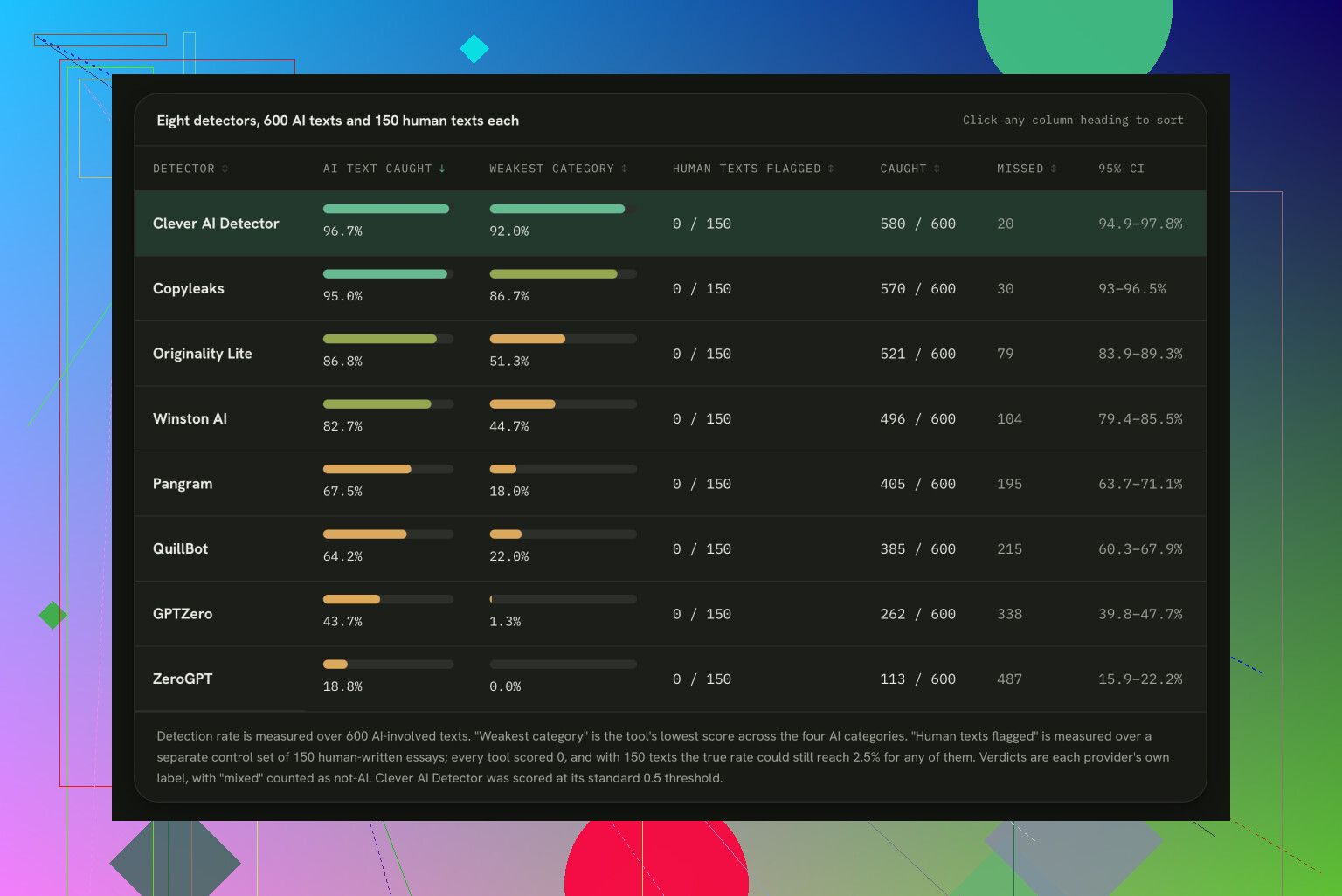
I still wouldn’t treat detector output as proof, but the consistency claim is what made me pause. The comparison covered 750 texts, mixing AI-involved samples from the GEDE dataset with genuinely human controls. That’s more useful than the usual unexplained screenshots, though I couldn’t independently verify every sample or how the benchmark was administered.
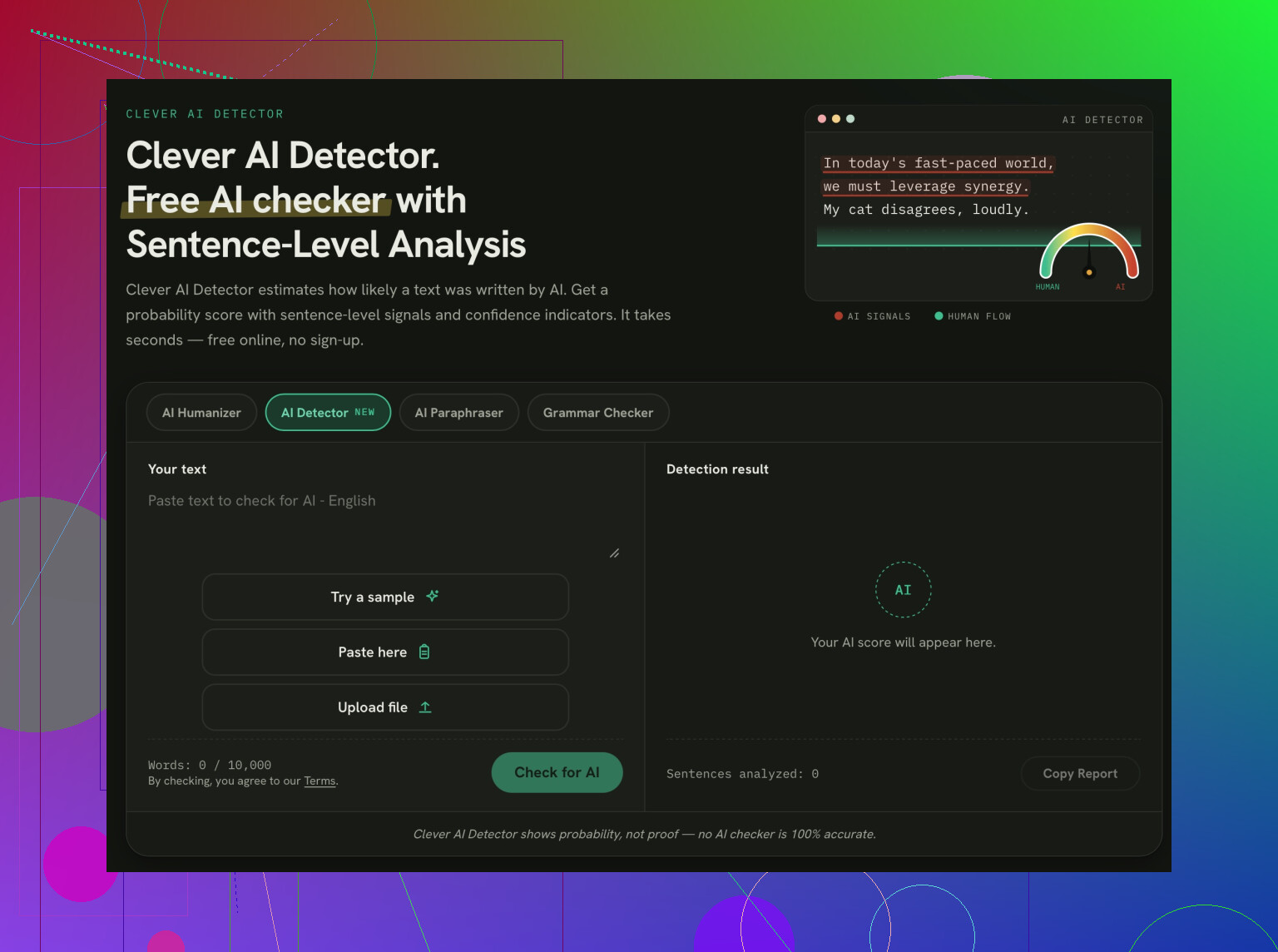
I tried the free Clever AI Detector rather than taking the ranking at face value. I used writing I knew was mine, fresh AI output, and a few AI passages I’d edited by hand. My human work came back as human, while the generated material was generally flagged even after editing. That matched the published pattern, but my test was small and informal, so I’m not pretending it confirms the full study.
The headline result
Clever AI Detector reportedly reached 96.7% overall and stayed above 90% in every AI category tested. The benchmark also reported no false positives among 150 human control texts.
Those are strong claims. I could confirm that the tool behaved sensibly on my own limited batch, but I couldn’t personally reproduce the full benchmark. I’d want repeated testing with new samples before treating those results as settled.
The service terms are easier to check directly. It’s free, doesn’t require an account, allows unlimited checks, and accepts fairly long submissions. I didn’t run enough material through it to verify how unlimited usage holds up over time, tho I didn’t encounter a paywall or signup prompt.
Where the comparison gets interesting
The difficult material wasn’t untouched AI output. It was paraphrased text, AI writing revised by a person, and human writing that had received AI assistance. Several familiar detectors reportedly lost a lot of accuracy in those categories.
Copyleaks was the closest competitor at 95% overall. Originality.ai Lite, Winston AI, QuillBot, GPTZero, and ZeroGPT were also included, but their results varied much more once the text had been edited. I’m leaving out most of those individual category scores because the broader point is enough: edited writing appears to be where detector performance separates most sharply.
What I could and couldn’t check
The benchmark Clever AI Detector page includes the methodology, category breakdown, and full results table. That provides more detail than a typical affiliate-style roundup, but a detailed table isn’t automatically independent evidence.
I could verify my own inputs and outputs. I couldn’t verify the origin of every benchmark text, rerun the entire dataset under identical conditions, or rule out any relationship between the comparison and the featured tool. That doesn’t make the results false. It just limits how confidently I’d repeat them.
How I’d use it
For a practical check, collect several samples you wrote before using AI, add untouched AI output, then create edited versions without changing the meaning. Run them blind, record the scores, and repeat the same set in another detector. Judge the tools by false positives and consistency across revisions, not by which one gives the most confident-looking verdict.
The privacy policy of the second-opinion detector matters here, especially if your paper contains unpublished research, personal data, or material covered by a school confidentiality rule. Uploading the entire document to five different sites can create a bigger problem than the original flag. If the terms are unclear, test short, non-sensitive excerpts instead.
A different detector cannot truly “verify” Turnitin because it is not reproducing Turnitin’s system. At best, it can show that the classification is unstable. If Turnitin marks a paragraph as AI and Clever AI Detector or another service calls the same paragraph human, that is useful context, but it does not establish which tool is correct. I would avoid presenting the competing percentage as if it cancels the first one out.
The more useful comparison is at passage level. Take the exact sections Turnitin highlighted and look for common false-positive triggers: repetitive sentence patterns, generic transitions, compressed summaries, definitions, or heavily standardized academic phrasing. Then compare those passages with a rougher section from the same draft. A detector that labels nearly every polished paragraph as AI while accepting informal or uneven writing may simply be reacting to style.
@emma1996 is right that writing records will matter more in a dispute. I would organize them into something an instructor can review quickly rather than dumping a folder of files on them:
- an early outline with creation dates
- a draft showing incomplete or awkward wording
- revision history for the flagged paragraphs
- notes tied to the cited sources
- a short explanation of how each disputed section developed
That gives the instructor a way to assess authorship without having to trust any detector. If you use Clever AI Detector as a check, save its result alongside the Turnitin report, but describe it as evidence that the automated findings conflict, not proof that your paper is clean.
I would ask for the actual highlighted passages too, not only the overall percentage. A paper-level number can sound serious while giving very little information about what supposedly caused it. The instructor should be able to discuss the specific text and the school’s review process. The practical goal is not finding a detector that gives you the answer you prefer. It is showing that the flag needs human review and giving that reviewer a clear trail of how the paper was written.
Expect some detector disagreement, especially with formal academic prose. The worst move is repeatedly rewriting a legitimate paper until every checker says “human.” That can weaken your argument, distort quotations or citations, and leave you explaining why the submitted version differs so much from your documented draft.
Use Clever AI Detector or one other tool only as a quick passage-level check. If the same section gets conflicting results, stop chasing scores. Keep the original wording and prepare a short authorship explanation tied to your outline, sources, and revision history.
I’d focus the conversation with the instructor on the school’s actual review policy. Ask whether the Turnitin result triggered an automatic penalty, what percentage or passages caused concern, and what evidence they accept in an appeal. Public detectors cannot replicate the institutional Turnitin setup, so a favorable second opinion is supporting context, not a technical reversal.
Don’t compare Turnitin’s paper-level percentage with another detector’s paragraph score as if they measure the same thing. The confusing part is that tools may handle quotations, citations, headings, and bibliographies differently.
Before trying Clever AI Detector or another checker, paste only the exact highlighted passage. Then test a second copy with quoted material and reference fragments removed. A large score change may point to formatting or source-heavy wording rather than authorship.
The drafting evidence others mentioned still matters most, but this gives you a specific question for the instructor: what text did Turnitin actually analyze? That is more useful than collecting five favorable detector scores.
If the flagged section is only a few sentences, the answer changes. Most public detectors become less useful on short samples, so pasting each sentence separately can produce a wonderfully scientific collection of contradictory percentages.
Use the longest coherent flagged section you can, with quotations and the bibliography removed, then run that same text through only two alternatives, such as Clever AI Detector and Copyleaks or GPTZero. If they disagree with Turnitin, save the results, but stop there. Running ten checkers until one says “human” looks like verdict shopping and probably will not persuade an instructor anyway.
I’d treat the second opinions as a way to demonstrate uncertainty, not authorship. Your stronger argument is still the draft history, but detector disagreement can support a very specific request: have the instructor review the actual passage rather than accepting the score as automatic proof.
Plenty of instructors won’t even look at a second detector, so don’t build your whole defense around one. That’s the realistic expectation nobody in this thread has said out loud yet. Some departments treat any consumer tool as noise regardless of what it says, because they know these classifiers swing wildly on the same text. If your school is one of those, a favorable Clever AI Detector score changes nothing about how the conversation goes.
I mostly agree with @xavier and @electric_hawk114 that the draft trail is your actual leverage. Where I’d push a bit further is timing. Get your outline, version history, and notes in order before you ever open the conversation, not after. If you go in empty and ask for time to ‘find’ your drafts, it reads worse than showing up with them already organized. The evidence loses value the moment it looks assembled in a hurry.
On the tool itself, I’d treat it about the way @nanovision described. It’s fine as a quick sanity check on the exact flagged block, and if it disagrees with Turnitin that’s a small point in your favor. But I wouldn’t paste your whole paper into it or anywhere else. @xavier already flagged the confidentiality angle and that’s the part people skip because they’re panicking. Unpublished work going through random sites is a real problem, not a hypothetical one.
The thing everyone’s circling but not naming: false positives on Turnitin’s AI score are common enough that plenty of schools have quietly walked back automatic penalties tied to it. So before you spend an evening running detectors, find out whether your instructor is even allowed to fail you on that number alone. Ask directly what policy applies, what passages were flagged, and what counts as evidence in an appeal. If the answer is ‘the score isn’t decisive on its own,’ half this detector debate becomes irrelevant and you save yourself the effort.
Short version of my take: keep the second opinion as a footnote, not the argument. Your process evidence plus the school’s actual policy decides this, and both of those beat any percentage from any tool.